
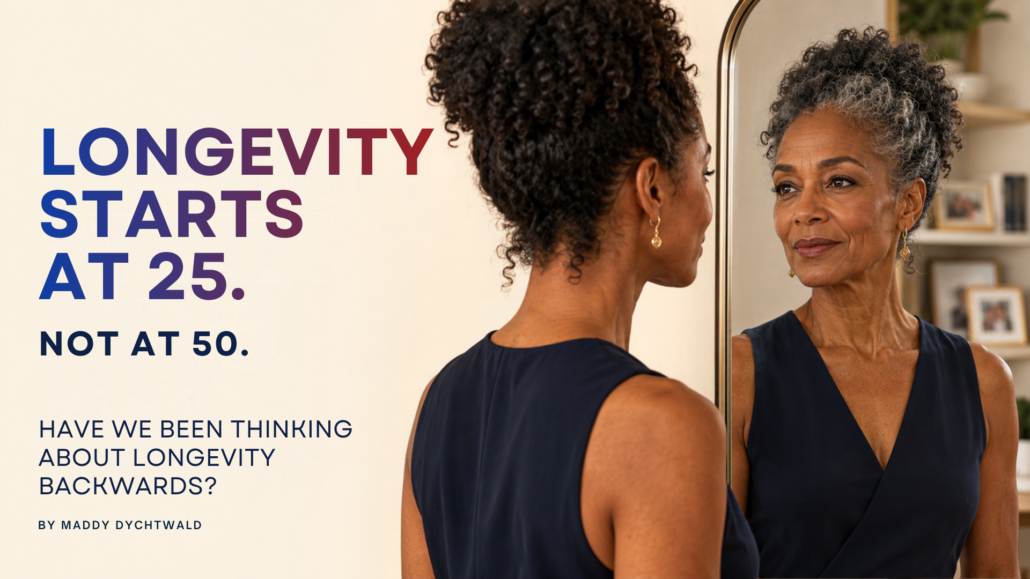
Have We Been Thinking About Longevity Backwards?
By Maddy Dychtwald
We’ve been treating longevity as though it begins at 50.
It doesn’t.
The longevity revolution is not a story about being old longer. It is a story about what happens when all of us live longer—and our families, workplaces, financial systems, healthcare institutions, and communities have to change along with us.
Consider what is happening in the United States. We are approaching a historic demographic turning point when older adults will outnumber children. In 1950, adults 65+ represented roughly 8 percent of the population. Today, they account for about 18 percent. And by 2030, every baby boomer will be 65 or older.
We hear numbers like these and immediately picture retirement communities, Medicare, Social Security, nursing homes, and caregiving.
That may be where we get longevity backwards.
Because a country with more older adults isn’t simply a different country for older people.
It’s a different country for everyone.
It changes who works and for how long. Who provides care. Who pays for it. How families organize themselves. How employers think about careers. How we save and spend. And how responsibility moves between generations.
Every 25-year-old today will build a career, a family, and a financial life inside this new longevity economy.
Yet we spend surprisingly little time preparing them for it.
Consider caregiving. Nearly one in four American adults is part of the sandwich generation, simultaneously helping an aging parent while raising or supporting a child. Among adults in their 40s, the squeeze is even greater.
Younger generations can see what is coming. Many members of Gen Z expect that caring for aging parents—financially, physically, or both—will become part of their lives.
And that responsibility may arrive at exactly the moment they are trying to establish their own financial footing: building careers, buying homes, starting families, paying off debt, and saving for futures that could last 90 or 100 years.
But I want to be very clear about something.
Older adults are not the burden.
The burden is an infrastructure that failed to keep pace with longevity.
We added decades to life without redesigning life for the added decades.
Our institutions were largely built around a much shorter lifespan: educate when young, work for several decades, retire around 65, and expect a relatively short period of life afterward.
That model no longer fits.
A 65-year-old today may have another 20 years ahead—and many will have considerably more. Yet our systems for work, education, retirement, healthcare, caregiving, and financial planning still largely reflect the old map.
Then we wonder why families feel stretched.
This may be both the central challenge and the extraordinary opportunity of the longevity revolution.
Instead of asking individuals and families to somehow absorb the consequences of longer lives, we need to begin redesigning the systems around them.
What if education prepared us not simply for our first career, but for several—especially as AI transforms the world of work?
What if employers expected people to move in and out of work, caregiving, learning, and reinvention across much longer working lives?
What if financial planning began at 25 with the possibility of a 100-year life rather than waiting until retirement appeared on the horizon?
What if caregiving were treated as essential economic infrastructure rather than a private family problem?
These aren’t questions just for older adults.
They are questions for all of us.
Because longer lives are not simply a challenge to solve. They are an extraordinary opportunity.
More years can mean more time to learn, earn, contribute, create, care, reinvent, and begin again.
Employers that understand this can attract and retain talent across generations. Financial institutions can help clients plan for much longer lives. Governments can build policies around the population we are becoming rather than the population we used to be.
And individuals who understand longevity early can make decisions at 25, 35, and 45 that profoundly change what is possible at 75, 85, and 95.
The longevity revolution may be one of the greatest opportunities of our time—but only if we stop treating it as just an older adult’s issue.
Longevity belongs in how a 25-year-old plans a career.
How a 40-year-old navigates caregiving.
How a 55-year-old reinvents.
How an employer designs work and benefits.
How a financial advisor plans for a client’s future.
And how a country prepares for the decades ahead.
Maybe the biggest shift we need to make is also the simplest:
Longevity isn’t just about older adults.
It’s about all of us.
And the earlier we understand that, the better prepared we will be to make the most of the longer lives already arriving.
If we started teaching longevity at 25 instead of 50, what would we teach first?
